
Systems thinking and enterprise UX · MSc final project · 2025
The Employee Value Loop
Understanding the systems
behind employee experience.
Organisations depend on employees, but employees also depend on the conditions around their work. This MSc project explored those connections through the Employee Value Loop: how culture, leadership, technology and everyday information shape employee experience, customer service and business value. The practical response was an Employee Hub concept.
- Contribution
- Systems thinking, research framing, interdisciplinary synthesis, enterprise UX, information architecture and formative evaluation
the visible problem.
01 · Background
Employee difficulties raised questions about organisational conditions.
Placement observations raised questions about how business problems and employee difficulties were understood. Delays, repeated firefighting and unclear responsibilities were visible, but the conditions contributing to them were less obvious.
The early notes asked which problems are noticed first. An issue that appears to involve technology may also involve training, priorities, workload or culture. Understanding those connections was the starting point for deciding what to investigate.
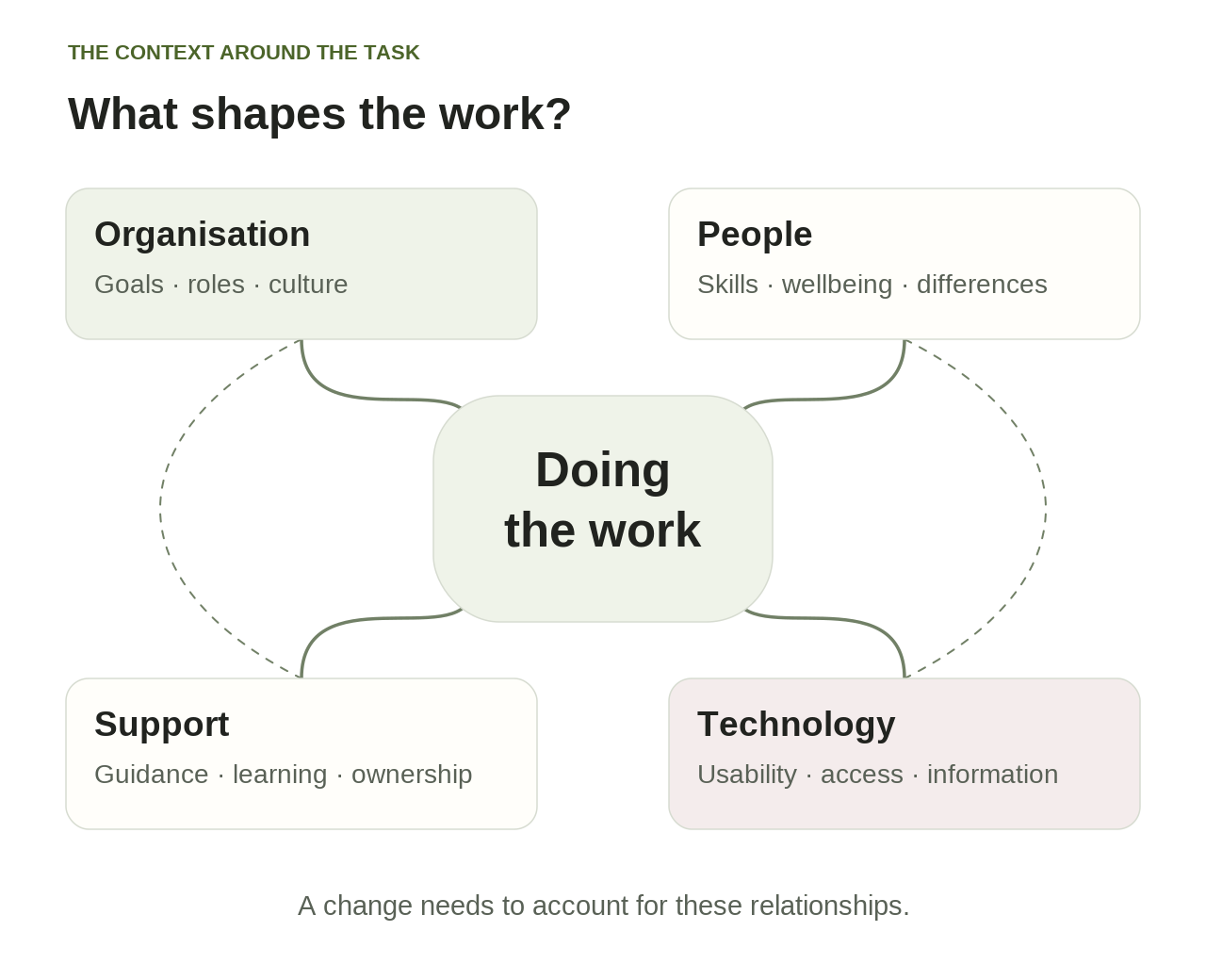
This shaped the project’s approach to organisational change. A change to one part of a system can create new demands elsewhere, so the relationships need attention before a solution is chosen.
The visible problem was a starting point for investigation.
02 · Conceptual model
Working conditions connect employee and customer experience.
The Employee Value Loop connected the organisation, its employees and its customers. The business provides working conditions, tools, clarity and support. Employees bring their skills, motivation, wellbeing and individual differences to that environment.
The loop explored how employee experience could affect the products and service customers receive, and how business outcomes could feed back into the capacity to support employees. It was a conceptual model for examining those relationships.
Clarity and findability were central to this view of employee experience. Locating trusted information, understanding a decision and knowing who owns a task are all part of having the support needed to do the job.
03 · Research approach
The research combined organisational and individual perspectives.
The research approach needed to account for the organisation and the individual working within it. Systems thinking informed the framing, design thinking supported exploration, and ISO 9241-210 provided a human-centred structure for understanding context, developing responses and evaluating them.
The literature review connected work psychology, organisational design, culture and enterprise UX. Early planning separated assumptions from questions that needed investigation.
An exploratory survey and unstructured interviews gathered perspectives across organisational contexts. The survey helped identify patterns, while interviews explored the circumstances behind them. Anonymous survey links were chosen to reduce concerns about feedback being associated with an employer account.
04 · Research findings
Findability depended on ownership, context and trust.
Survey responses described asking colleagues to find information, delays around approvals, uncertainty about document versions and limited visibility of work. Interview material was organised into eight themes, including accountability, leadership, tools, collaboration and time pressure.
These findings connected information problems with the way work was organised. Search could help locate a file, but people still needed to know whether it was current, who owned it and how it related to their task.
Personas and jobs to be done translated the research into three needs: locate and verify information, understand status and responsibility, and record information without entering it repeatedly.
05 · Design scope
The Employee Hub focused on shared information and support.
An intranet offered a practical place to explore those needs within the wider system. Limited time and organisational access kept the design work focused on an Employee Hub concept.
Shared resources, company news and support had a common starting point. Department and project spaces kept work in context, while external sharing followed a separate route.
Navigation alone could not keep the information useful. The proposal also depended on named owners, guidance and training, alongside decisions about leadership, accountability and culture.
06 · Information architecture
The concept made document ownership and version details visible.
Information architecture was treated as part of employee experience. Consistent naming and clear browse and search routes addressed finding information. Visible ownership helped explain who was responsible for it.
The homepage brought together quick links, project status and recently updated documents. Owner, version and update-date details gave users context for judging whether a document was appropriate to use.
Requirements set out how the proposal could be evaluated. One target was for at least 90% of users to locate and verify a known document within 10 seconds. This was an evaluation target, not an achieved result.
07 · Testing and iteration
Tree testing informed navigation labels and grouping.
Two formative tree-test rounds in Optimal Workshop examined the navigation hierarchy. Labels and grouping were revised between rounds, bringing related resources together under Company Resources and clarifying the employee-support route.
Each results screenshot records three completed sessions. The tests informed the next version of the hierarchy. They did not establish the usability of the complete hub or demonstrate wider organisational change.
08 · Outcome and reflection
The concept needed further evaluation in an organisational setting.
The work produced a conceptual framing, research synthesis, jobs to be done, requirements, a revised information architecture and intranet concepts. A heuristic review identified further work on feedback, error recovery and contextual help.
Full prototype evaluation remained unfinished. Effects on adoption, productivity, wellbeing and business outcomes were not demonstrated. Further evaluation would need to examine the complete experience in a real organisational context.
The project’s approach to organisational change began with relationships: question the assumed problem, understand what influences it and choose a response with those dependencies in mind. Improving a tool is one contribution; the working conditions around it also need attention.