
Project at a glance
Challenge: Explore how a study robot could be understandable, useful and acceptable to students.
Research people & robots
- HRI and robotics review
- Student surveys and interviews
- Robot image and video studies
Shape the concept
- Thematic and scale analysis
- Teachable study companion
- Persona and interaction scenarios
Prototype interactions
- Dialogue and expressive cues
- Gesture and colour concepts
- Paper and animated prototypes
Evaluate & refine
- Scenario-based student testing
- Usability score: 62 (SUS)
- Speech response: 3 of 5 trials
Output: Research-led robot concept and tested prototypes. Speech recognition and control clarity needed further refinement.
Human-robot interaction · University project · 2024
Finn
A study companion
that learns from the student.
A research-led HRI project exploring how students perceive robots and a study companion that learns from the student through conversation, expression, gesture and visual cues.
- Contribution
- Robotics and HRI research, UX research, multimodal interaction design and usability evaluation
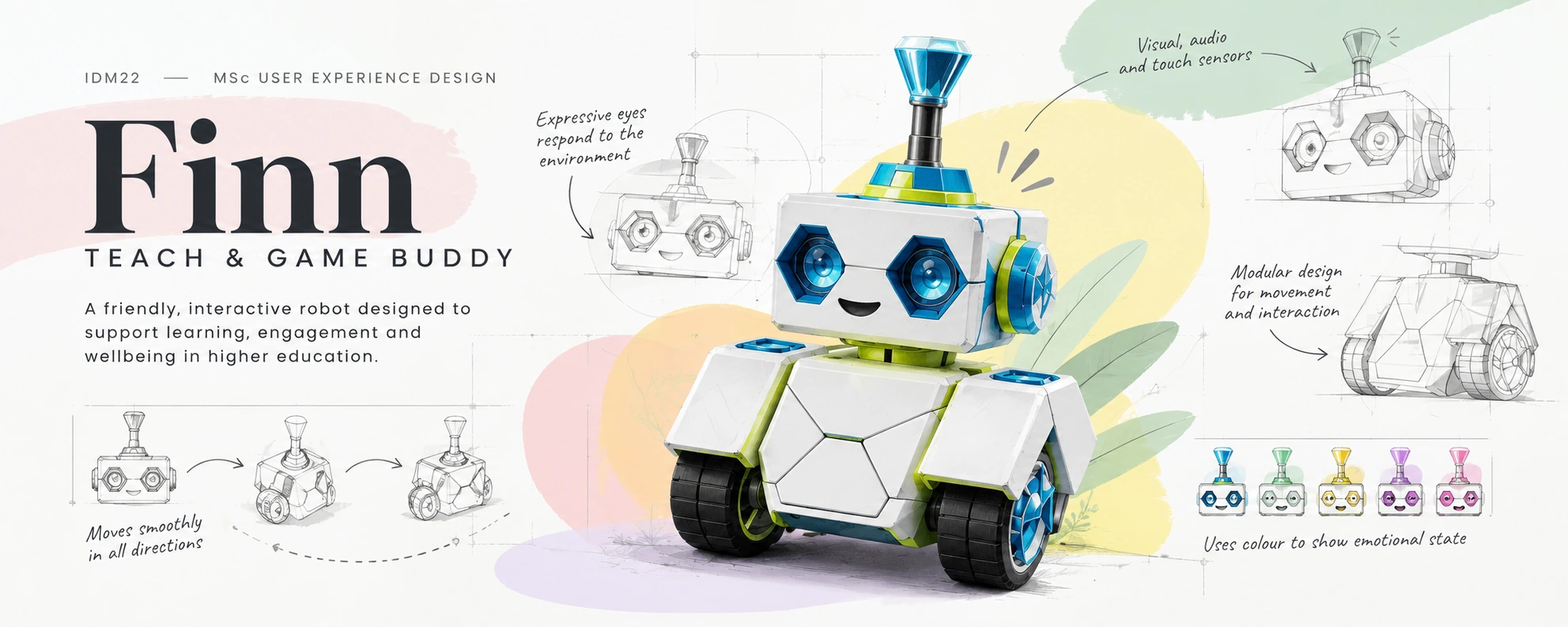
and interaction.
01 · Background
Finn explored a robot study companion for university students.
Finn explored how a desk-based social robot might support university students experiencing academic pressure, low motivation or stress. Its physical form and behaviour could influence whether students understood, trusted or felt comfortable with it.
The project considered student needs alongside the capabilities and limits of robotic systems. The intended role was a supportive study companion, with human and professional support remaining separate.
The research considered behaviour and physical form as parts of the interaction.
02 · Background and user research
Research examined student needs and perceptions of robots.
A literature review covered HRI, robotics, trust, appearance, social behaviour, education, motivation and student wellbeing. It also examined how sensors, actuators, software and physical form affect a robot’s capabilities, including the limits of behaviour that appears socially convincing.
Exploratory student research combined surveys, interviews, robot-image ratings and a video experiment. The Psychological Wellbeing scale explored student needs, and the Godspeed Questionnaire supported comparison of robot designs. Surveys were scored against the scale guidance; interviews and open responses were coded into themes.
Purpose mattered
Familiarity and a clear use were associated with greater acceptance and perceived usefulness.
Preferences varied
Some students preferred less human-like robots; others were uncomfortable with robots altogether.
Support needs differed
Wellbeing averages were relatively lower for autonomy, environmental mastery and positive relationships.
03 · Concept development
Students would teach Finn study and coping strategies.
Research themes included stress, coping strategies, motivation, time management, reassurance, social support and perceived robot functionality. These informed a persona, empathy map, user needs and questions for developing the concept.
Finn reversed the usual teaching relationship. Students could teach it study and coping strategies, then ask it to recall what it had learnt. The student took the expert role, with optional badges, levels and avatar customisation to recognise progress.
Teaching the robot gave students an active role in the concept.
Teach
Share a study or coping strategy with Finn.
Recall
Ask Finn to retrieve what it has learnt.
Recognise progress
Explore optional badges, levels and customisation.
04 · Interaction design
Dialogue, expressions and visual cues shaped the interaction.
The interaction model included exchanges started by the user and by Finn: teaching a strategy, recalling advice, attempting a coping-skills challenge and checking progress. Prompts and acknowledgements showed what to do next and how to continue or end an exchange.
Expressions and visual cues were developed alongside speech. HRI research and participant feedback informed this behaviour, with care taken to avoid implying emotional understanding beyond the system’s capabilities.
Conversation
Prompts, acknowledgement and supportive responses.
Expression
Faces, gesture, head movement and animation.
Visual feedback
Eye colour and a head light to communicate state.
Physical input
Touch, buttons and screen controls explored as possibilities.
05 · Prototyping and testing
Prototypes tested dialogue, controls and basic speech recognition.
Early sketches allowed the form, expressions and flow to change before detailed modelling. In a participatory design session, students drew robot ideas and responded to Finn’s expressions, colours and shape.
The low-fidelity prototype used paper dialogue, a cardboard robot with changeable faces and basic browser-based speech-to-text. A higher-fidelity concept added a refined model, animation and browser-based recognition. Sensor and movement ideas remained design explorations.
Scenario-based sessions with students aged 18 or over took place in a quiet study room. Think-aloud, observation, task performance and error recording were combined with BMIS mood measures, SUS, Product Reaction Cards and a participant debrief.
The prototype tested aspects of the interaction; it was not an autonomous robot system.
06 · Evaluation findings
Participants liked the concept but found interaction problems.
Participants described Finn as engaging and enjoyable, with positive responses to the teachable concept and gamified elements. They also wanted richer interaction and emotional responses. Some were unsure what buttons did or were unfamiliar with gaming-style controls.
The feedback pointed towards clearer controls, a familiar compact form and more understandable visual and expressive feedback. Speech recognition remained a practical constraint.
- speech-to-text attempts returned the intended response
- 3 of 5
- Basic browser-based prototype
- System Usability Scale score
- 62
- Further usability refinement was needed
- BMIS mood score, before and after
- 41 to 58
- Short-term self-reported measure
07 · Outcome and reflection
Further work was needed on recognition and control clarity.
The project produced a multimodal robot concept supported by user research, interaction flows, a persona, iterative prototypes and usability evaluation. Research into robotics and student perceptions informed the interaction choices.
Evaluation identified usability changes and implementation limits. Sustained wellbeing improvement and a fully integrated autonomous system were not demonstrated. Further work would need to address recognition reliability, clearer controls and the richer interaction participants requested.
Positive reactions to the concept were considered alongside its usability limits.